
What Type of Therapy Is Right For Me? A Guide to Finding Your Therapy Style

The Mind unSCRIPTED:
Finding Your Perfect Therapy Match in Hong Kong
Feeling lost, overwhelmed, or just... empty? You aren't broken. You are human. And in a city that never sleeps like Hong Kong, the pressure to be "on" 24/7 is immense. But what if the solution isn't just a quick fix, but a complete rewire?
Therapy isn't just about "fixing" a problem; it's about understanding the narrative of your life. And just like no two stories are the same, no two therapy approaches are either. Choosing the right one is the first and most crucial step toward reclaiming your mental health.
What’s the Difference?
Therapy vs. Psychotherapy vs. Counselling

You’ve probably heard these terms used interchangeably, but they serve different purposes.
Counselling: This is often short-term and solution-focused. It helps you deal with immediate, present-moment issues like a career change, a relationship conflict, or adjusting to a new life situation. It’s about "here and now" problem-solving .
Psychotherapy: This is the deep dive. Psychotherapy is a long-term process that explores the "why" behind your patterns. It looks at past experiences, deep-seated beliefs, and how they influence your current behaviors and emotional responses. It’s not just about managing symptoms but transforming the underlying causes .
Therapy: This is the umbrella term that covers both.
In essence, counselling helps you navigate a storm; psychotherapy helps you understand why you keep sailing into them.
Common Myths About Therapy (Demystified)
Let’s bust some myths right now.
Myth #1: "Therapy is only for people with serious mental health issues." False. Anyone can benefit from therapy. It’s a sign of strength, not weakness . In Hong Kong, many seek it for life transitions, not just clinical disorders .
Myth #2: "Therapy is too expensive." False. While costs can vary, many insurance plans cover it. In Hong Kong, some workplace insurance packages include mental health support. It is an investment in your most valuable asset: yourself .
Myth #3: "I should be able to handle this myself." False. The brain is an organ; sometimes it needs a personal trainer. Just as you'd see a physio for a back injury, you see a therapist for your mental health .
Myth #4: "Therapy is just talking to a friend." False. Therapy is a scientifically backed process. It is a professional alliance designed to facilitate change and healing using evidence-based techniques .
How Does Therapy Actually Work? (The Mechanism)
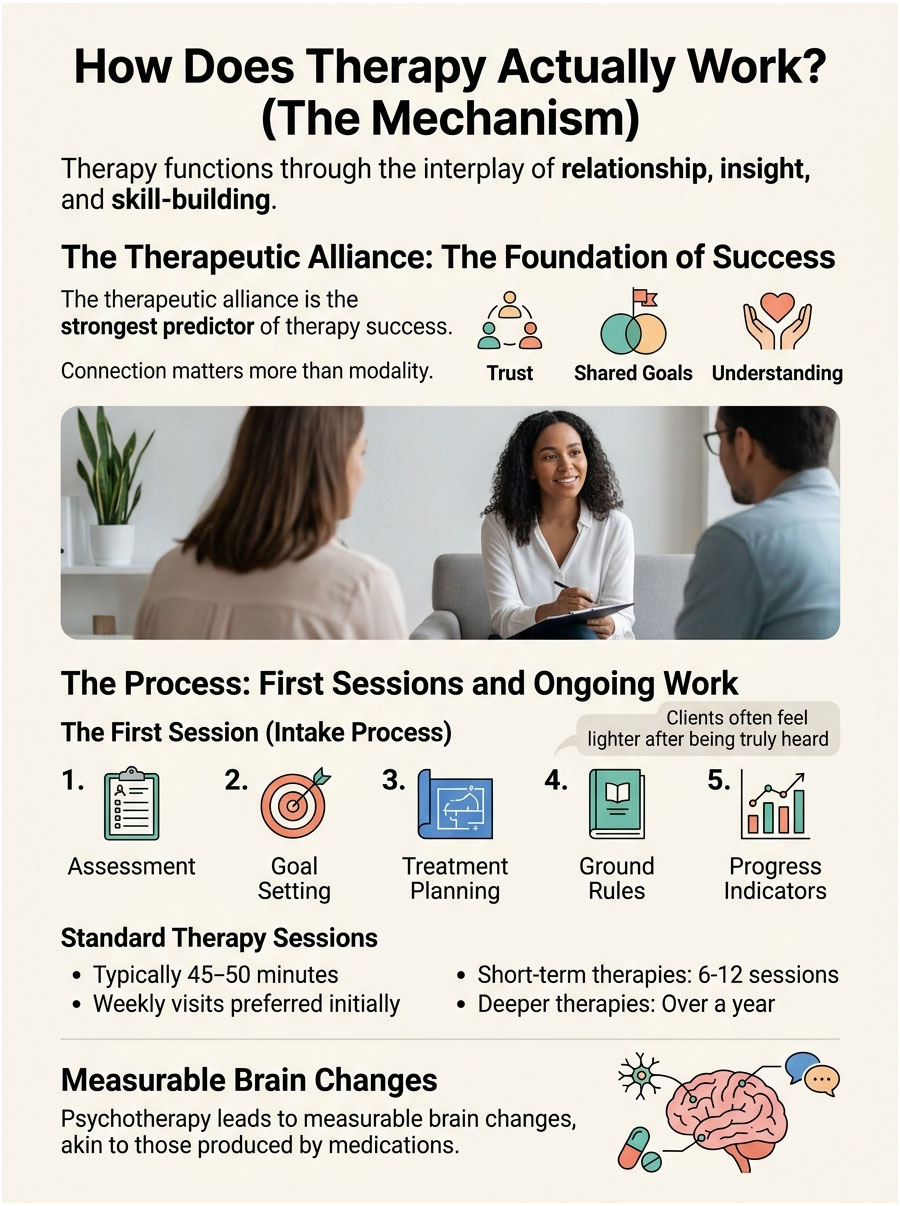
Therapy isn’t magic; it’s science. It works by creating a safe, confidential space to explore your inner world. Through the guidance of a trained professional, you begin to untangle the knots of your mind.
The process helps you:
1. Identify maladaptive patterns.
2. Understand their origins (often linked to childhood or past trauma).
3. Reframe the narrative you tell yourself.
4. Adopt healthier coping mechanisms for the future.
The Therapeutic Alliance
(The #1 Predictor of Success)
Here is the most critical factor in therapy: the relationship. Studies consistently show that the bond you form with your therapist—known as the "therapeutic alliance"—is the single most predictive factor of whether therapy works .
This isn't just a "like" or "dislike"; it's a feeling of being:
Heard: Feeling truly understood.
Safe: Knowing you can share anything without judgment.
Trusted: Believing your therapist has your best interests at heart.
If you don't "vibe" with your therapist, shop around. It’s completely normal to try a few before finding the right fit.
What Happens During Your First Session
(Step-by-Step)
The unknown is scary. Demystifying the process can reduce your anxiety.
1. Intake & Paperwork: You'll likely fill out forms about your history and current concerns.
2. Building Rapport: The therapist will introduce themselves and the process, focusing on making you feel comfortable .
3. The "Get to Know You" Phase: They will ask about your background, your family, and why you decided to seek therapy now .
4. Goal Setting: Together, you’ll start to set broad goals. What do you hope to get out of this? .
5. No Pressure: You are in control. You can ask questions about their style or approach. The first session is as much for you to assess them as it is for them to assess you .
Duration, Frequency, and Length of Sessions
Frequency: Weekly sessions are the gold standard for consistency, but many therapists offer bi-weekly (every two weeks) options to fit your schedule and budget .
Duration: A standard session lasts about 50-60 minutes.
Length of Treatment: There is no set timeline. It could be 6 sessions for a specific short-term goal, or it could be several years for deep-seated trauma. It all depends on the "depth" of the work being done .
How Therapy Changes the Brain
(Neuroplasticity)
Yes, therapy actually rewires your brain. This is called neuroplasticity. When you engage in new ways of thinking and behaving, your brain forms new neural pathways.
Weakening Old Pathways: By not engaging in negative thought loops (rumination), you stop reinforcing those pathways.
Strengthening New Ones: By practicing cognitive restructuring (like in CBT), you literally build a "highway" for healthier, more positive thoughts.
12 Types of Therapy Explained
So What Type of Therapy Is Right For Me?
Let's debunk some here :

Type of Therapy | Best For | How It Works |
Cognitive Behavioral Therapy (CBT) | Anxiety Disorders:
| Identifies and changes negative thought patterns and behaviours |
Psychodynamic Therapy | Relationship issues, Grief | Focuses on how you relate to others and how these relationships affect your mental health |
Internal Family System (IFS) | Relationship issues:
| A powerful, evidence-based psychotherapy model. It views the human mind not as a single personality, but as a complex "internal family" of sub-personalities ("parts"). The goal is to heal wounded parts and restore harmony under the guidance of a core, compassionate Self. |
Dialectical Behavior Therapy (DBT) | Borderline Personality Disorder (BPD), Extreme emotional regulation | Combines CBT with mindfulness to manage intense emotions and conflicts. |
Humanistic Therapy | Low self-esteem, Identity issues | Emphasizes self-acceptance and personal growth in a non-judgmental environment. |
EMDR , RITMO therapy | Trauma, PTSD, T-PTSD | Uses eye movements and bilateral tapping to help the brain process traumatic memories |
Family Therapy | Family conflict, Parenting issues | Views the "family" as a system and works on communication patterns. |
Couples Therapy; Gottman method therapy |
| Couples therapy focuses on the relationship dynamic rather than any single individual. It provides a neutral, safe space for partners to identify dysfunctional patterns, improve communication, resolve conflicts, and strengthen emotional intimacy |
Mindfulness-Based Therapy | Stress, Anxiety, Burnout | Uses meditation and awareness to help you stay grounded in the present |
Solution-Focused Brief Therapy | Specific goals, Life transitions | Focuses on solutions for the future rather than analyzing the past |
Art Therapy | Trauma, Children | Uses creative expression as a tool for communication and healing |
Play Therapy | Children with behavioral issues | Uses play to help children express feelings they can't articulate verbally |
7 Signs You Should Start Therapy This Month

You are the only one who can truly know when you need help. But if you recognize these signs, it's time to act:
1. You feel sad, anxious, or irritable most of the time for more than two weeks.
This isn’t just a "bad day"; it's a pattern.
2. Sleep or appetite have changed significantly.
Are you sleeping 12 hours or 3? Always tired from the moment you wake up ? Eating everything or nothing? These are biological red flags.
3. You are using alcohol, food, or social media to numb out.
Are you scrolling to avoid your feelings?
4. People close to you have said you seem "off."
Listen to the people who know you best. They often see the change before you do.
5. Despite trying hard, performance at work is dropping.
The brain fog is real.
6. You are constantly ruminating.
You can't stop replaying the same argument or thought in your head.
7. Have you just thought about not wanting to be here?
This is a major red flag. Even a passive thought of "I wish I could disappear" is a reason to seek help immediately.
How Much Does Therapy Cost in Hong Kong?
Public Sector (HA/Hospital Authority): Can be heavily subsidized but waitlists are often long.
NGOs (e.g., Caritas, HK Family Welfare Society): Offer sliding-scale fees based on income, usually starting around HKD 300-500.
Private Practice (Psychologists/Counsellors): Typically ranges from HKD 800 to HKD 2,000+ per session. Psychotherapists often charge at the higher end. Psychiatrists (who prescribe meds) are even more expensive.
Insurance: Check your policy. Many corporate plans now include coverage for clinical psychologists.
Online vs. In-Person: Which is Right for You?

Online Therapy: Offers flexibility and convenience. No need to commute (a huge bonus in Hong Kong!). It’s great for busy professionals or expats. However, you might miss out on some non-verbal cues .
In-Person: Provides a safe, guided environment that is separate from your home and work. It can feel more focused and "real."
Is Therapy Actually Effective? The Evidence

Yes. Abundantly so. Studies show that approximately 75-80% of people who enter psychotherapy show some form of benefit . The evidence is so strong that the combination of medication and therapy is often more effective than medication alone for conditions like depression and anxiety .
What Does "Progress" Look Like in Real Life?
Progress isn't linear. You won't wake up "cured."
You’ll feel more in control: You stop reacting; you start responding.
Your sleep improves: Your mind isn't racing as much at 3 AM.
You handle conflict better: You don't go into full "fight or flight" mode when a partner gets upset.
The "voice" in your head is gentler. You are kinder to yourself.
When Therapy Doesn't Work
(And How to Fix It)
Therapy can fail, but it’s usually not the "patient's / client's" fault. It's often a poor fit.
The Alliance is Bad: You don't trust your therapist. You can't be open with them.
Wrong Modality: CBT might not work for a trauma survivor who needs EMDR first.
Being "Stuck": You might be in a phase where you don't want to change (secondary gain).
Solution: Talk to your therapist about it. A good therapist will adjust their approach or refer you to someone else. This is a sign of a great professional, not a failure.
Next Steps: How to Start Therapy This Week
1. Acknowledge the feeling. The fact that you're reading this article means you're ready.
2. Do your research. Use the grid above to decide what you need.
3. Use a directory. Look up reputable platforms for HK therapists, counsellors, psychologists or psychiatrists, or this website.
4. Make the call. Send an email. Book the consultation. That 1-minute move is all it takes to start the process.
5. Be patient. Finding the right therapist is like dating. It might take a couple of tries.
" Are you feeling the weight of Hong Kong's fast-paced life?
Do you recognize yourself in any of these 7 signs?
Don't wait until a crisis hits.
Book that consultation this week.
Your future self will thank you. "
📍 THE PROCESS HK - Individual, family and couples therapy,
Mental Health Support in Sheung Wan, Central Hong Kong


Comments